
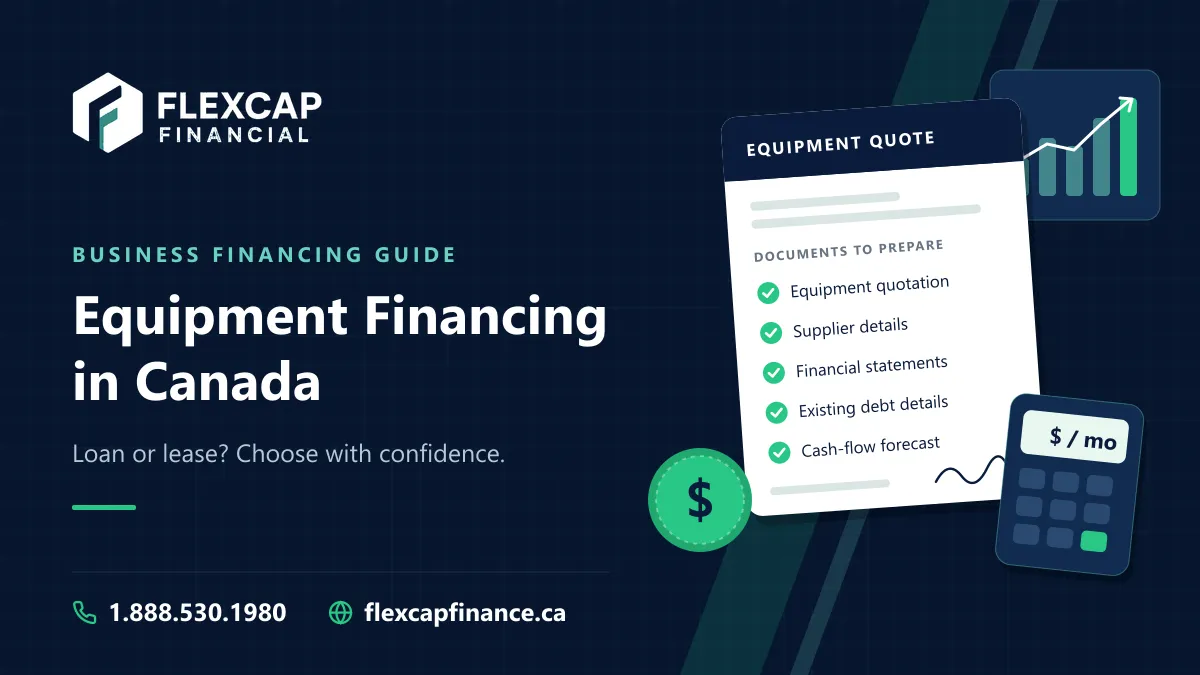
Businesses often need new equipment to take on larger contracts, improve productivity, replace aging machinery, or expand operations. However, paying the full purchase price upfront can put pressure on working capital and day-to-day expenses.
Equipment financing in Canada can help eligible businesses acquire productive assets through financing arrangements structured around the equipment purchase. Depending on the lender, asset, and application, options may include equipment loans or leasing arrangements.
The right option depends on how the equipment will be used, its expected useful life, your cash flow, and the financing terms available to your business.
This guide explains the main options, what lenders may consider, which documents to prepare, and how to compare financing arrangements before making a decision.
What Is Equipment Financing?
Equipment financing is a way for a business to fund the acquisition of equipment without necessarily paying the entire purchase price upfront.
The arrangement may involve borrowing funds to purchase an asset or entering into a lease agreement. Terms, ownership rights, payment schedules, and end-of-term options vary by provider and contract.
Businesses may explore financing for assets such as:
- Construction equipment: excavators, loaders, cranes, and other heavy machinery.
- Commercial vehicles: trucks, vans, trailers, and fleet vehicles.
- Manufacturing equipment: production machinery, processing equipment, and industrial tools.
- Warehouse equipment: forklifts, material-handling machinery, and storage systems.
- Restaurant and hospitality equipment: commercial ovens, refrigeration units, and food-preparation equipment.
- Technology and specialized equipment: eligible computers, business technology, and industry-specific assets.
Eligibility depends on the equipment, its intended business use, the applicant's financial position, and the provider's requirements.
How Does Equipment Financing Work in Canada?
Although the process differs between providers, most equipment financing applications follow a similar sequence.
1. Identify the equipment your business needs
Start by identifying the asset, its business purpose, and the problem it will solve. Consider whether the equipment will increase production, replace an existing asset, reduce operating delays, or support a new contract.
2. Calculate the full acquisition cost
Look beyond the equipment's advertised price. Depending on the purchase, additional expenses may include delivery, installation, taxes, accessories, training, maintenance, and insurance.
Understanding the full cost helps you assess how much funding may be required and whether the expected payments fit your operating budget.
3. Compare loans and leasing arrangements
Review available financing structures, repayment periods, upfront costs, interest or other financing charges, fees, ownership terms, and end-of-term obligations.
Do not compare offers using the monthly payment alone. A lower payment may result from a longer term or different ownership conditions.
4. Prepare your application
Providers may ask for a supplier quotation, equipment specifications, business details, financial information, and details about existing obligations.
Having the information ready can make the application process more organized, although it does not guarantee approval.
5. Review the offer before signing
Check the complete agreement, including total repayment, payment frequency, fees, security requirements, insurance obligations, early repayment conditions, and any residual or end-of-lease amount.
Ask questions about anything that is unclear before accepting an offer.
Equipment Loan vs. Equipment Lease: What Is the Difference?
A loan and a lease can both help a business access equipment, but they may work differently.
| Comparison | Equipment loan | Equipment lease |
|---|---|---|
| Basic structure | Financing is used to purchase the equipment. | The business obtains the right to use equipment under a lease agreement. |
| Ownership | The business generally owns the purchased asset, subject to applicable security interests and contract terms. | Ownership generally remains with the lessor unless the agreement provides an option or process to acquire it. |
| Payments | Payments typically repay principal and financing costs. | Payments are based on the lease structure and contractual terms. |
| End of term | The loan may be repaid while the business retains the asset, subject to the agreement. | The business may need to return the equipment, renew the lease, or exercise a purchase option if available. |
| Potential consideration | Useful when ownership is a priority and the repayment structure fits the business. | Worth exploring when access to equipment and the contract's flexibility suit the business's needs. |
Neither option is automatically better. Compare the total cost, ownership implications, tax and accounting treatment, and flexibility of each arrangement with an appropriate financial or tax professional.
What Do Lenders Consider When Reviewing Equipment Financing?
Lenders and financing providers use their own assessment criteria. Depending on the transaction, they may consider the following factors.
Business financial position
Providers may review revenue, cash flow, profitability, existing debt, and the business's capacity to meet the proposed payments.
Time in business and ownership details
Business history, ownership structure, and the experience of the owners may be relevant to the application.
Equipment details and business purpose
The asset's price, condition, supplier, resale value, expected useful life, and intended use may influence the financing assessment. Requirements can differ for new and used equipment.
Credit history and repayment capacity
Credit information and the overall financial position of the applicant may be considered. Some arrangements may also require a personal guarantee or security, depending on the provider and transaction.
Important: Approval criteria, required documentation, down payments, and available terms vary. No particular approval outcome should be assumed before a provider reviews the application.
Equipment Financing Application Checklist
Preparing the right information before applying can help you compare options and respond to provider questions.
Use this checklist as a starting point:
- Equipment quotation, invoice, or purchase proposal.
- Equipment make, model, age, condition, and specifications, where applicable.
- Supplier or dealer details.
- Business registration and ownership information, if requested.
- Recent business financial statements or bank statements, if requested.
- Information about existing loans and other financial obligations.
- An estimate of ongoing operating, maintenance, and insurance costs.
- A cash-flow forecast showing how the equipment will support operations and how payments may be managed.
- Details of any deposit or contribution you expect to make.
- Information about the contract, project, or business expansion the equipment will support.
Not every provider requires every document. Confirm the exact requirements before submitting sensitive financial information.
Can You Finance Used Equipment?
Used equipment may be eligible for financing, but availability depends on the provider and the asset.
Factors that may affect eligibility include:
- The equipment's age, condition, and expected remaining useful life.
- The purchase price and available valuation information.
- Whether the equipment can be inspected or independently assessed.
- The seller's details and the documentation available.
- The asset's intended use and suitability for the business.
- The provider's policies for used or specialized machinery.
Before committing to a used asset, confirm that the financing provider will consider it. Also evaluate repair costs, replacement parts, downtime risk, and maintenance requirements.
Are Government-Backed Financing Programs Available?
Canadian businesses may wish to investigate the Canada Small Business Financing Program (CSBFP) when considering eligible equipment purchases.
The program is designed to improve access to financing for qualifying small businesses. Eligible uses, limits, and conditions are governed by the program's rules. Participating financial institutions deliver and assess the financing; businesses do not receive automatic approval simply because a purchase may qualify.
Start with the official resources:
- Canada Small Business Financing Program — Frequently Asked Questions
- Government of Canada — Helping small businesses get loans
Eligibility and program terms should be confirmed directly with a participating financial institution before making a purchase or assuming that a particular expense is covered.
Common Equipment Financing Mistakes to Avoid
Focusing only on the monthly payment
A lower payment does not necessarily mean a lower overall cost. Compare the total amount payable, term, fees, and any end-of-contract obligations.
Underestimating operating costs
Equipment can create ongoing expenses for maintenance, fuel, insurance, training, repairs, and storage. Include these costs in your budget.
Choosing the wrong financing term
A term that is poorly matched to the equipment's useful life or the business's cash flow can create unnecessary financial pressure.
Ignoring contract conditions
Read the agreement carefully, especially any security requirements, early repayment fees, usage restrictions, residual amounts, and return conditions.
Applying before preparing the necessary information
Incomplete information can lead to follow-up requests and delays. Gather the available equipment and business documentation before starting.
How to Choose the Right Equipment Financing Option
Before deciding, answer these five questions:
- What business outcome will the equipment support? Identify the operational need and expected benefit.
- How long will the equipment remain useful? Consider its expected working life and replacement cycle.
- What payment structure fits your cash flow? Evaluate affordability under normal conditions and during slower business periods.
- Do you need ownership or flexibility? Consider whether purchasing or leasing better suits your plans.
- What is the total cost of each offer? Compare financing charges, fees, upfront contributions, and end-of-term obligations.
A financing arrangement should support your business objectives without creating an avoidable strain on working capital.
Explore Equipment Financing with FlexCap Financial
FlexCap Financial offers an equipment finance pathway for businesses exploring financing for productive equipment, vehicles, heavy machinery, and specialized assets.
If your business is planning an equipment purchase or replacing an essential asset, begin by outlining the equipment required, the amount you may need, and how the purchase supports your operations.
Explore the FlexCap Financial financing solutions page to learn more and identify the appropriate starting point for your financing request.
Financing is subject to lender criteria, credit approval, and applicable terms. Availability, eligibility, and final conditions depend on the specific transaction.
Visit: https://flexcapfinance.ca/
Contact: 1.888.530.1980 | info@flexcapfinance.ca
Frequently Asked Questions About Equipment Financing in Canada
What is equipment financing in Canada?
Equipment financing allows a business to fund the acquisition or use of equipment through an arrangement such as an equipment loan or lease. Availability and terms depend on the asset, provider, and applicant.
What types of equipment can businesses finance?
Depending on the provider, eligible assets may include construction machinery, commercial vehicles, manufacturing equipment, forklifts, warehouse equipment, and other business-use assets.
Is it better to take an equipment loan or lease equipment?
Neither option is universally better. A loan may suit a business that prioritizes ownership, while a lease may suit a business whose needs align with the lease's usage and end-of-term conditions. Compare total costs and contractual obligations before deciding.
Can a Canadian business finance used equipment?
Some providers finance used equipment. Eligibility may depend on the asset's age, condition, valuation, remaining useful life, and the provider's policies.
What documents are needed for equipment financing?
Providers may request an equipment quotation, supplier details, business ownership information, financial statements, bank statements, existing debt details, and information about the equipment's intended use. Exact requirements vary.
Can a new business qualify for equipment financing?
A newer business may be considered by some providers, but eligibility depends on the financing program, the owners' financial circumstances, the asset, and the overall application. Approval is not guaranteed.
Is a down payment required for equipment financing?
Some arrangements require an upfront contribution, while others may have different funding structures. The amount, if any, depends on the provider, asset, credit assessment, and transaction.
Can equipment financing help preserve working capital?
It may help a business avoid paying the entire equipment cost upfront. However, financing creates ongoing payment obligations, so the business should assess the effect on cash flow and total costs.
Can the Canada Small Business Financing Program help with equipment purchases?
Potentially, for eligible businesses and eligible equipment costs under program rules. A participating financial institution assesses the application and determines whether financing can be offered under the program. Confirm current requirements with the institution.
How long does equipment financing approval take?
There is no universal approval timeline. Processing depends on the provider, the complexity of the transaction, the asset, and whether all required information has been supplied.
References and further reading
- BDC — Equipment financing: A step-by-step guide
- Government of Canada — CSBFP Frequently Asked Questions
- Government of Canada — Helping Small Businesses Get Loans
- FlexCap Financial — Financing Solutions
Disclaimer: This article is for general informational purposes only and does not constitute financial, legal, tax, or accounting advice. Financing eligibility, product availability, rates, fees, and conditions vary by provider and applicant. Verify current terms with the relevant financing provider.